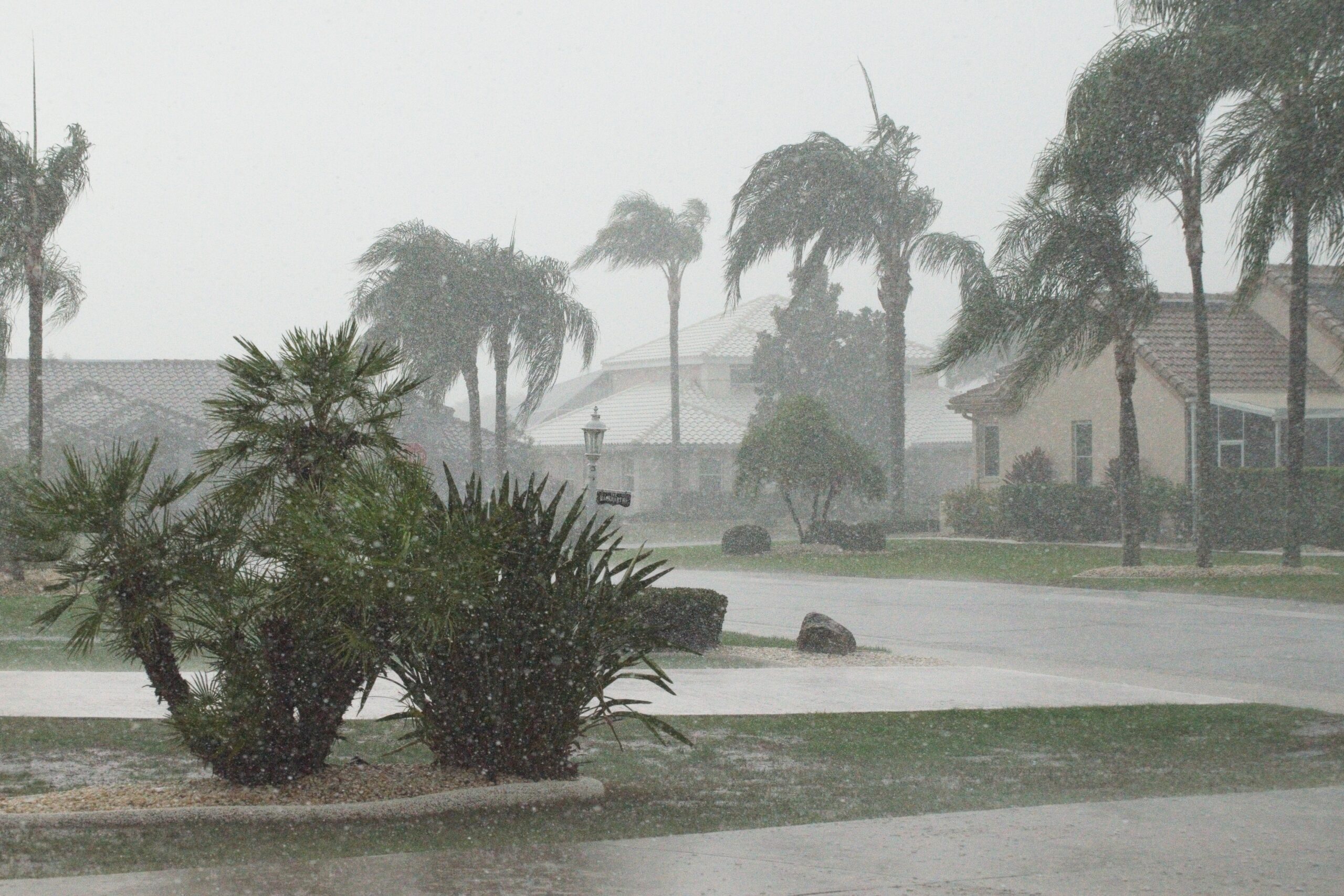
Hurricane resistant landscaping in South Florida comes down to three things: a yard that drains, a surface that stays put, and nothing loose that high winds can turn into debris. A well-installed artificial lawn helps with all three. It has no topsoil to wash out, no sod to tear up and no mud after the storm, and when its edges and seams are secured on a compacted, draining base, it stays where it was laid. What turf won't do is stop flooding: if your yard or street floods, water sits on turf just as it sits on grass until the ground and the storm drains can take it. Here is how an artificial lawn behaves before, during and after a hurricane or tropical storm, and what makes the rest of your landscape storm-ready.
It can be a strong part of one, with honest limits. No lawn is "hurricane-proof". What artificial turf changes is what a storm can do to the yard:
The weak points are the edges, the seams and the base. Those are what to check before hurricane season and after every storm.
Most of a lawn's hurricane resistance is decided on installation day, long before a storm is in the forecast.
We build the base from crushed aggregate, laid in layers and compacted with a plate compactor, with a fine leveling layer on top, graded with a slight slope away from the house. Rain then both drains through and runs off. A base that was too thin or never compacted settles, holds water and lets the turf move, and a storm finds those spots first. Many South Florida lots have a high water table and low spots, so yards that already hold water get extra drainage before the base goes down; our drainage base option uses #57 stone and limestone screenings. Read more about the best base for artificial turf in Florida soil.
Some turf drains only through punched holes, which can clog with sand and pollen. A backing that drains everywhere moves heavy rain into the base faster. Our PX80 and Pet Turf both drain through the whole backing. For how that compares with a natural lawn, see why artificial grass with drainage beats natural turf.
Wind gets under turf at an edge or an open seam, not in the middle of the lawn, so the perimeter matters most:
Infill holds the turf down, keeps the fibers upright and protects the backing. A lawn whose infill has thinned out is easier for wind and water to move, so keep it topped up.
When a hurricane or tropical storm is coming, the turf itself needs very little. The yard around it needs more:
On balconies and rooftops, bring loose turf rugs and tiles inside. Rolls taped or glued at the edges can stay, as long as the drain is open.
A well-installed lawn mostly just takes the rain. Water passes through the fibers and backing into the base, and what can't drain fast enough sits on the surface until it can. The fibers bend in the wind and come back up. The real risks come from outside the turf:
Once it's safe to go outside, a quick inspection tells you whether the lawn needs a cleanup or a repair.
Remove large debris by hand first: branches, palm fronds, roof pieces, glass and nails. Then clear oak leaves, smaller debris and sand with a leaf blower or a plastic rake. Don't drag heavy branches across the turf, and never use a metal rake; it pulls fibers and tears the backing. Leaves left on the lawn break down in the infill and feed weeds and odors, so get them off within a few days.
Some water on the surface during and right after heavy rain is normal. Water that keeps sitting in the same spots long after the rain stops points to a low spot in the base, compacted infill or a clogged backing. Let the yard dry, then test it: pour a bucket of water on a dry section, and if it's still puddled an hour later, drainage is the problem.
If pet areas start to smell a few days later, rinse them and use an enzyme cleaner made for turf; if the odor keeps coming back, have the base checked.
A loose edge can sometimes be re-nailed at home. A tear, a lifted seam, a sunken area or turf that no longer drains needs a repair. Our artificial turf cleaning and repair crew removes debris, power-brushes the fibers, tops up infill and re-secures seams and edges, for turf we installed and turf from any installer, and replaces damaged sections when a repair isn't enough. Often only one section needs replacing, not the whole lawn.
One storm rarely does, if the lawn was installed properly and the debris comes off quickly. What shortens turf life is what a storm exposes: a base that holds water, edges that lift every season, infill that's gone. Quality turf on a good base typically lasts 15 to 20 years in South Florida; read how long artificial grass lasts in Florida. Turf warranties usually exclude damage from hurricanes, floods and other acts of nature, so check what your homeowner's policy covers before the season.
Most storm damage in a yard comes from trees and what falls from them, so turf is only one piece of a hurricane-resistant landscape. The rest is general good practice for trees and shrubs in South Florida:
A landscape built this way, with draining turf, healthy trees and nothing loose, is far simpler to clean up after a major hurricane. Landscaping, tree and drainage rules vary by community. Check with your city and HOA before you make changes.
A lawn secured at the edges and seams, on a compacted base and with enough infill, is very hard for wind to get under. Loose rugs, tiles and edges that were never secured are what lift.
Turf doesn't cause flooding and doesn't prevent it. It drains into the base and the ground beneath, so when the ground is saturated or the area floods, water stays on the surface until it can drain.
No. Leave it in place and uncovered, secure what's loose around it, and check the edges and seams.
Take out the flags and cups. A green's base is contoured to send surface water off, so once debris is cleared it's usually playable soon after a storm.
If you're planning a new lawn, our turf starts at $8.50 per sq ft installed, and the artificial grass cost calculator gives you a starting price. If you already have turf, we can check the base, edges and seams before hurricane season. We work across Palm Beach and Broward counties, including Boca Raton, Delray Beach, Boynton Beach, West Palm Beach and Fort Lauderdale. Call (561) 210-0999 for a free site visit.