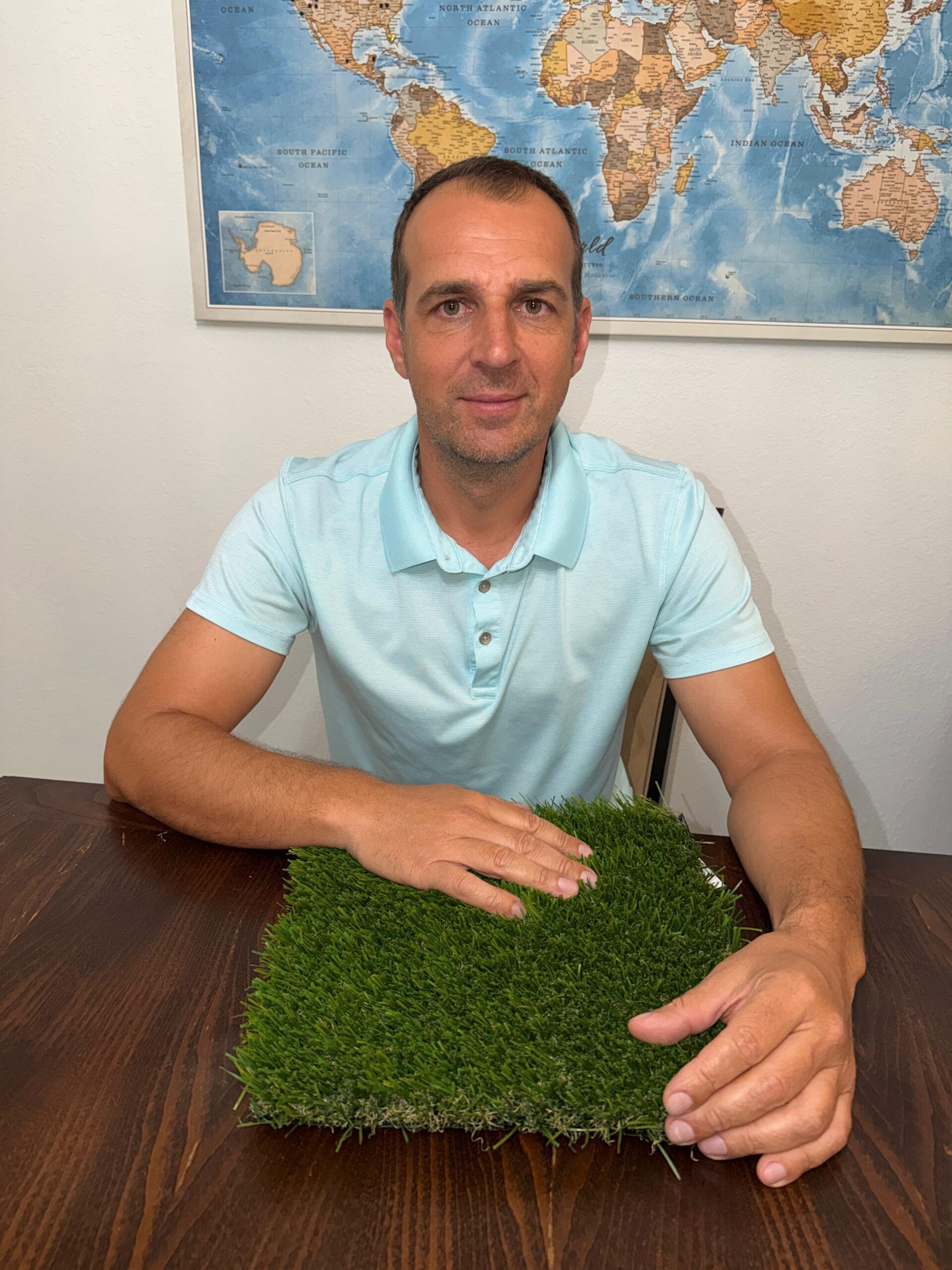
I get asked this a lot, usually right at the beginning of a project. After nearly twenty years in this industry, I can tell you this: the name has never decided how a field performs. The system does.
I’ve stood in factories, watched the fibers being made, seen the rolls come off the line. The machines don’t know what the product will be called later. The same polymers are melted, extruded into fibers, tufted into a backing, coated, cured, and tested. Polyethylene, polypropylene, UV stabilizers, pigments — it’s the same chemistry. Whether someone labels it synthetic or artificial comes much later, usually in a marketing meeting, not on the production floor.
On site, it’s the same story. I’ve installed turf sold as “artificial” on sports fields and turf sold as “synthetic” in high‑end residential yards. Once it’s unrolled, nobody can tell the difference by looking at it. What you notice instead is how it drains after a storm, how hot it gets in the sun, how the fibers recover after traffic. Those things are driven by pile height, density, infill choice, and backing quality — not by the word used to describe it.
This is where marketing tends to simplify things too much. It suggests that choosing the right term means choosing the right product. In reality, performance lives below the surface. I’ve seen premium‑branded turf fail quickly because the base was rushed or drainage was ignored. I’ve also seen more modest products perform for years because the sub‑base was graded properly, compacted correctly, and matched to the climate.
Sports fields, backyards, playgrounds, rooftops — they all use variations of the same turf technology. What changes is how the system is engineered for use, traffic, and weather. A soccer field doesn’t fail because it was called artificial instead of synthetic. It fails because water can’t move through the base, or because shock absorption was designed on paper but not built in the ground.
When clients ask me which one they should choose, I usually turn the question around. How much use will it see? What does the soil look like underneath? How much rain do you get? How will it be maintained? Once those answers are clear, the turf choice becomes obvious — and the name becomes irrelevant.
I’ve seen this work, and I’ve seen it fail. Every time it failed, the problem wasn’t the label. It was the structure underneath. What you see on top is only the final layer. That’s as true for synthetic turf as it is for artificial turf.